
If I hear one more marketing guru tell a small business owner to “just run ads” and “post consistently,” I might scream.
This advice is a death sentence for your wallet.
You don’t need budgets of Crores. You need proven zero cost marketing strategies for small businesses in India that actually work without burning cash.
Sure, running ads might get you some followers or orders, but your Customer Acquisition Cost (CAC) will shoot up, and it will eventually bleed your pocket dry.
Let’s be real: “Posting consistently” is a lie. In 2026, the only thing that makes you go viral is psychology. You need to trigger an emotion so deep that people feel forced to share your content with others.
I have analyzed three brands from the Indian startup ecosystem that spent almost zero to go viral.
Here is exactly how they did it, and how you can steal these zero cost marketing strategies for your own business.
Table of Contents
Why Zero Cost Marketing Strategies Work Better Than Ads
Most founders think paid ads are a shortcut to growth. In reality, they are a trap. When you pay for ads, you are renting attention. The moment you stop paying, the traffic stops.
Zero cost marketing strategies, on the other hand, build assets. When you go viral organically, you earn trust, not just views.
Here is the difference that matters:
- Trust: People scroll past “Sponsored” posts but share “Authentic” stories.
- Longevity: An ad dies in 24 hours. A viral case study (like Wakefit’s) brings traffic for years.
- CAC (Customer Acquisition Cost): Ads increase your CAC over time. Organic strategies drive it down to near zero.
The following three Indian brands didn’t just save money—they built empires by refusing to pay for the ads. Here is how they did it.
The Whole Truth
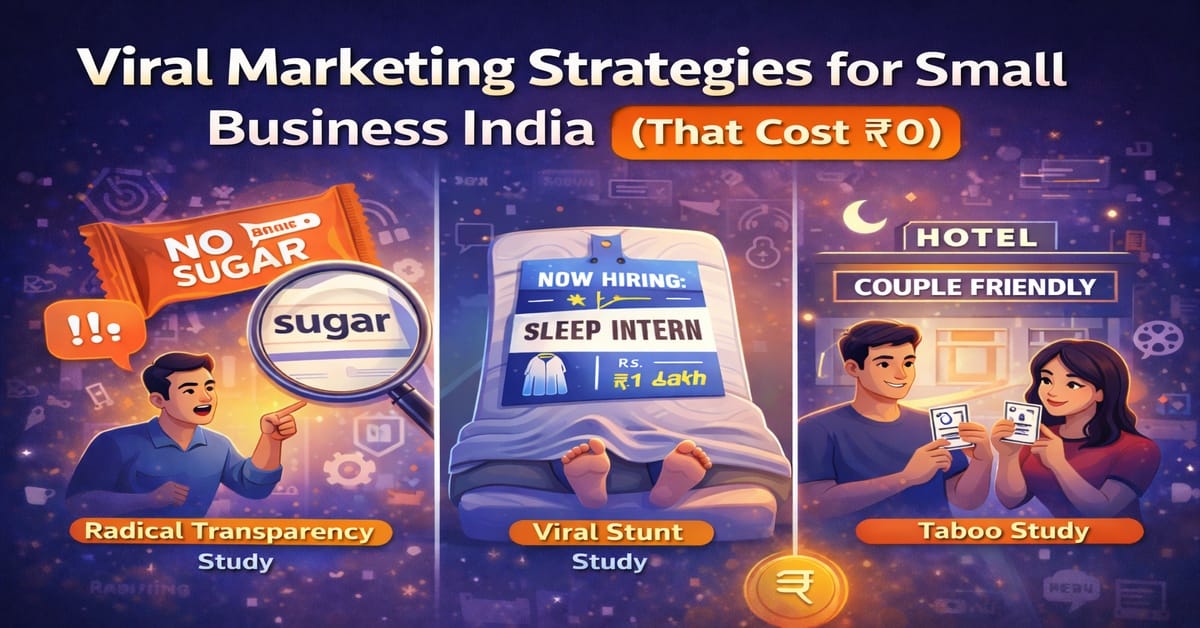
Case Study 1: The Whole Truth – The “Radical Transparency” Strategy
Most self-proclaimed healthy brands in India treat customers like children. To look healthy, they replace real ingredients with some healthy-sounding words—like replacing “sugar” with “apple juice concentrate.”
This is where The Whole Truth found a gap and started with the motive to provide healthy products, that too without adding sugar, and to transparently label their products.
The Execution
The Whole Truth, a protein bar brand, picked a fight with the industry. They did not just sell products—they also exposed the lies of their competitors.
Shashank Mehta, the founder, instead of hiring a model to advertise the bars, himself made simple videos showing how self-proclaimed healthy companies cheat customers by replacing unhealthy ingredient names with some healthy-sounding words.
This video on YouTube got 8 million views, which in turn increased customer trust in this brand by 20%.
There were some other campaigns too, like “Choli Ke Peeche” protein parody and “What’s Inside?”
Why It Went Viral
It triggered indignation. When people watched their content, they did not just feel informed—they felt angry too. They felt like they had been cheated by other brands for years. And when people feel cheated, they share the content to save their friends who have been eating junk in the name of healthy food. This proves that zero cost marketing strategies often work better than paid ads because they are built on truth, not hype.
Your Action Plan: Everyone selling good you start exposing bad.
- Find the “Industry Secret”: Every industry hides a dirty secret. Identify the one thing your competitors hope the customer never finds out. (Example: Many clothing brands use bleach that might be poisonous to the body).
- Teach, Don’t Preach: Create content that teaches your customers how to catch those tricks. Don’t just say “We are safe.” Show them how to test it. (Example: “3 simple ways to check if your clothes have been bleached”).
- Win by Default: Once you educate your customers with the truth, you don’t need to sell hard. They will choose you because you are the only one who proved that you truly care about them.
Wakefit
Case Study 2: Wakefit (The Viral Stunt Strategy)
Imagine it is 2015, and you go to buy a mattress and find that the mattress costs more than the bed itself. It hurts because you have to empty your pockets and even your savings, especially if the mattress is for orthopedic purposes.
The same happened with Ankit, the founder of Wakefit. When he went to buy a mattress, he was already employed in the foam industry and knew the real cost of making one. A mattress takes ₹5,000 to make and was sold for ₹40,000, a 400–500% markup.
Wakefit did not want to sell foam: They had to fix the supply chain to bring the price down, so they fixed it by removing the middleman. But before fixing the supply chain, they wanted to fix the most important thing for their customers: Sleep. So they fixed it by designing special-purpose mattresses made with science to improve sleep quality.
But they faced a massive marketing problem: mattresses are boring. Nobody talks about them at parties. To win, they needed to make “sleep” cool again.
The Execution
Instead of traditional advertising, they pioneered one of the most creative zero cost marketing strategies in Indian startup history. Instead of spending crores on TV ads saying “Our foam is soft,” they created a viral marketing campaign that forced the entire country to talk about them.
They launched the famous Wakefit Sleep Internship.
They posted a job opening on social media that looked too good to be true:
- Role: Sleep Intern
- Job Description: Sleep for 9 hours in our mattress.
- Experience: Past experience in sleeping in any environment.
- Salary: ₹1 Lakh.
- Dress Code: Pyjamas.
Why It Went Viral
They triggered “Tagging Behavior.”
I must admit, if I came across such a posting, even I couldn’t stop myself from tagging my lazy friends. And that is exactly what happened. People didn’t just apply; they tagged their “laziest” friends in the comments.
This proves that humor is one of the most effective zero cost marketing strategies available today. It relies on the same psychological triggers found in the Zomato Marketing Strategy, but unlike Zomato, Wakefit executed this without burning a massive ad budget.”
The Result
Every tag was free distribution. Within days, the Wakefit sleep internship case study was covered by major news outlets like CNN and Mashable. They got Crores of rupees worth of PR for the cost of a few interns.
The Action: Everyone creates ads to be skipped, you create news to be shared.
- Turn your audience into distributors, not viewers: Design a campaign so engaging that it naturally requires an additional person to participate. For example, instead of choosing a brand name yourself for your next business, ask the public to choose it for you. The best brand name chosen wins a group tour.
- Challenge society’s thinking: Find what society says is bad but people secretly want. Make it good. For wakefit it was sleep. They made it a good thing to do, liberated millions who felt guilty about being tired, and those people shared like crazy.
OYO
Case Study 3: OYO (The “Taboo” Strategy)
“Bad Reputation.” Two words powerful enough to scare an entire industry. Imagine this: You are an unmarried couple looking for a hotel room to spend some quality time. It should be a simple process: You go to the desk, show your IDs, and get a key.
But back in 2016, it was a nightmare. Most hotels would deny you entry. Not because they lacked rooms, but because they feared Police Raids, Moral Policing, and Public Shame. The couples shared this fear. They weren’t asking for luxury; they were asking for something very basic: Safety and Privacy.
The Action
Ritesh Agarwal (OYO Founder) realized that “Judgment” was his biggest competitor. He decided to solve the “Moral Policing” problem that no other hotel chain dared to touch.
The Execution
He didn’t run a TV ad (which would have been controversial). He simply added a filter in the OYO app called “Relationship Mode” (later changed to “Couple Friendly”).
When you clicked this filter, it only showed hotels that welcomed unmarried couples with local IDs. He trained the staff at these specific hotels: “Do not ask questions. Do not judge. Just check the ID and give the key.”
Why It Went Viral
It triggered “Relief.”
Unlike Wakefit, people didn’t tag friends publicly because of the stigma. Instead, it went viral via “Dark Social” (WhatsApp DMs and private chats). When you solve a deep insecurity or fear for a customer, they don’t just become a user; they become a lifetime loyalist because you saved them from humiliation.
The Result
- Viral Word-of-Mouth: Couples didn’t post about it on Facebook (it’s private), but they whispered it to every friend. “Dude, use OYO. It’s safe.”
- Market Monopoly: OYO captured the entire Gen Z market overnight.
- Zero Ad Spend: They didn’t have to advertise. The Feature was the marketing.
Your Action Plan
You don’t need to run a hotel to do this. You just need to find the specific moment where your customer feels scared or shy, and design a way around it.
- Identify the “Friction Point”: Find the one moment your customer is afraid of. The moment they hesitate.
- The Problem: For decades, buying condoms in India was a nightmare. A man had to stand at a busy pharmacy counter and loudly ask for “Condoms.” The fear of being heard or judged was the friction.
- Create a “Silent” Solution: Don’t force your customer to be brave. Change your process so the awkward interaction disappears.
- The Fix: Manforce didn’t try to change society. They simply changed the vocabulary. They branded their product “MF.”
- The Bypass: Suddenly, the customer didn’t have to say the taboo word. They could just say, “Bhaiya, ek packet MF dena,” and the transaction was done without shame.
- The Result: By removing the need to say the “awkward word,” they removed the barrier to purchase.
Lesson: OYO did it with a “Filter.” Manforce did it with a “Name.” You can do it with a “Process.”
Conclusion
Marketing remains a vital part of any business. This may require paid ads, placements, and exposure. But if you are creative enough and solve a real customer pain point, then you do not need heavy budgets. You can achieve this by mastering zero cost marketing strategies. Look at what these three Indian brands achieved without spending a single rupee on ads.
- The Whole Truth didn’t have a budget; they had the Truth. They exposed the lies of their own industry.
- Wakefit didn’t have a celebrity; they had a Crazy Idea. They turned a boring mattress into a viral “Sleep Internship.”
- OYO didn’t have a massive PR team; they had Empathy. They solved the “Taboo” of unmarried couples that nobody else dared to touch.
The biggest lie is that you need massive funding. In fact, This One Business Decision Helped a Small Indian Brand Scale Faster Than Ads proves that zero cost marketing strategies often outperform big budgets.. In fact, when you have enough money, you become lazy. When you can’t buy ads, you are forced to be creative.
So stop waiting for funding. Stop paying for fake first steps. Go to your factory, look at the product, and ask yourself: What is the one truth about this industry that nobody is talking about?
Q1: What are the best viral marketing strategies for small business in India?
The best zero cost marketing strategies for small business in India are Content Marketing (exposing industry lies like The Whole Truth), PR Stunts (creating viral jobs like Wakefit), and Solving Taboos (killing embarrassment like OYO). These strategies work because they rely on psychology, not ad budgets.
Q2: Can I really do marketing with zero budget?
Yes. Zero budget marketing ideas are not a myth; they are a necessity for startups. You don’t need money to post a “Truth Bomb” on LinkedIn or create a “Safe Mode” service in your shop. You just need the courage to be different. Brands like MBA Chaiwala and Phool.co started with literally nothing but a unique concept.
Q3: How can I market a boring product without money?
If your product is boring, you are marketing it wrong. Wakefit sold mattresses (boring) by launching a “Sleep Internship” (exciting). The secret is to stop selling the “product features” and start selling an “extreme experience” or a “challenge” related to your product.
Q4: Is guerrilla marketing legal in India?
Yes, but you have to be smart. Guerrilla marketing examples like Burger King photobombing a celebrity or Fevicol gluing a coin to the floor are legal because they are “Stunts,” not “False Advertising.” The key is to be funny and clever, not deceptive.
Q5: How long does it take for a small business to go viral?
Viral success isn’t about time; it’s about the “Trigger.” The Whole Truth went viral with one video. OYO dominated the market with one app filter. If you hit the right emotional nerve (Anger, Humor, or Relief), your low-cost marketing strategy can go viral in 24 hours.



3 thoughts on “Zero Cost Marketing Strategies: How 3 Indian Brands Went Viral (Case Studies)”