
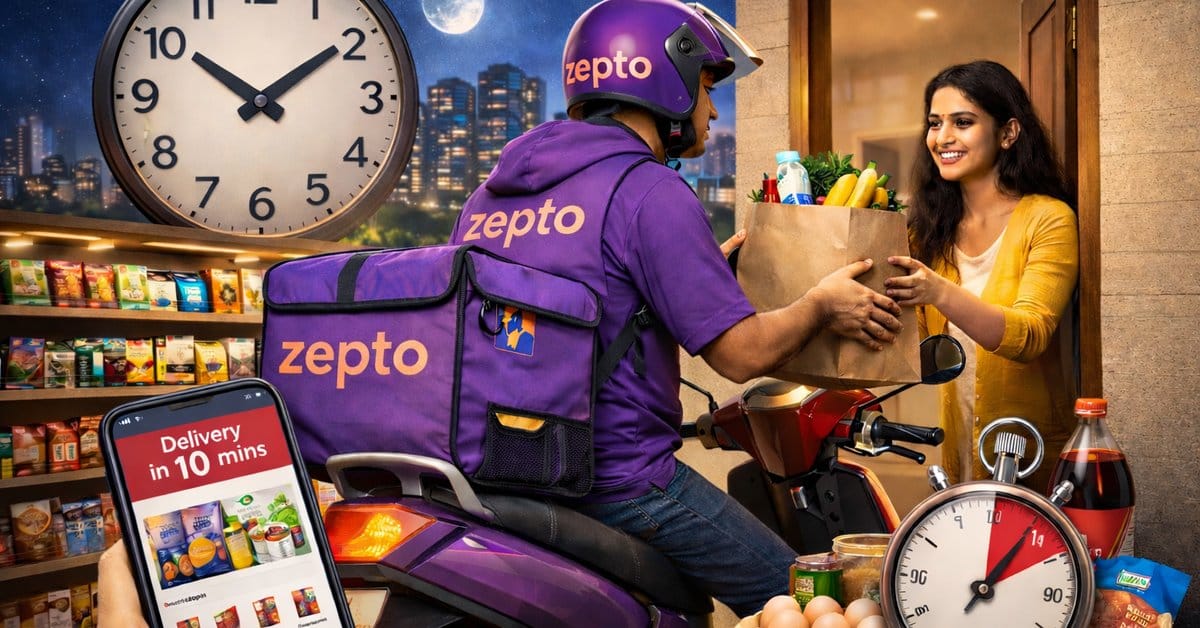
When you run out of milk at 11 PM, what do you do?
Five years ago, you would’ve waited till morning. Or rushed to the 24-hour store if you were lucky enough to have one nearby.
Today, if you live in any major Indian city, you probably just open Zepto.
And in 10 minutes, the milk is at your door.
But here’s what most people miss: why Zepto is successful in India is not because of 10-minute delivery alone. Speed is just the visible part. The real story of why Zepto is successful in India goes much deeper than that.
In just four years, two teenagers turned a pandemic WhatsApp group into one of India’s fastest-growing startups. Today, it processes over 1.5 million orders daily across Indian cities. The quick commerce company has become a genuine habit for millions of users.
Most delivery apps get tried once or twice, then forgotten. Zepto gets opened multiple times per week by the same people. That’s the difference between a service and a habit. And habits are what build billion-dollar companies.
So what’s really happening here? Why Zepto is successful in India, when bigger, better-funded competitors struggled?
In this article
1. Zepto Built “Customer Backward”, Not “Supply Chain Backward”
This is the first and most important reason why Zepto is successful in India
In the interview, Aditya explained that many early grocery delivery companies in India were building the business in the wrong direction. They were building the business supply chain backward, not customer backward. That sounds complicated, but it’s very simple.
Supply chain backward thinking means you start with questions like:
- What delivery time is economically possible?
- What model makes the logistics manageable?
- What feels feasible on paper?
That’s why many companies chose 2-hour delivery or 4-hour delivery models. Because it looked logical, practical, and safe. But Zepto started in the opposite direction. They started with the customer and asked:
- What do users want the most?
- What will make people come back?
- What will create retention and daily usage?
This is called customer backward thinking. And this shift is exactly why Zepto is successful in India. This strategy did not just work, it grew into a habit. Because when you build a product based on what the customer truly wants, the product feels natural. It feels like it belongs in the customer’s life.
2. Zepto Focused on Retention First (Not Just Growth)
This focus on retention is another major reason why Zepto is successful in India. Many startups fall in love with growth numbers. They focus on downloads, app installs, press coverage, company valuation, and advertising. They want to look big, even if users don’t return or use their app frequently.
In Zepto’s early days, numbers looked decent on the surface. People were downloading the app. Orders were coming in. But when they looked at retention data, the reality was brutal. Only 3-4% of users came back the next week, which means only 3-4 customers returned to the app.
That means even if people tried the app once, they didn’t turn into repeat customers. And without repeat customers, no delivery business can survive long-term.
Zepto didn’t ignore that reality. Instead of celebrating early growth, Zepto became obsessed with one metric: repeat purchase rate. They asked: “Why aren’t people repeating? What’s broken?”
And that mindset was important because the goal was never “a good first experience”. The goal was to become part of the customer’s weekly routine. That’s what retention means. Retention means people don’t just try you once. They return again and again. That’s when an app becomes a habit.
So they changed everything. They launched dark stores. They reduced delivery times. They took control of the full customer experience, and something dramatic happened in their first dark store location. That single neighborhood started generating more orders than the rest of the entire city combined. People weren’t just trying Zepto; they were replacing their default shopping behavior. That’s when you know why Zepto is successful in India, because they’ve built something real.
We’ve seen a similar retention-driven mindset in other Indian consumer brands as well. For example, Zomato’s marketing strategy focuses heavily on building recall, emotional connection, and repeat usage rather than just short-term conversions, which is why many of its campaigns keep going viral and stick in people’s minds.
3. 10-Minute Delivery Was Not a “Luxury” in India, It Was a Need
Most people outside India think 10-minute delivery is a luxury feature. But in India, it’s different. 10-minute delivery isn’t about luxury, it’s about matching how Indians already shop.
In India, people don’t buy groceries the same way people do in the US.
In India:
- Most consumption happens very close to home
- People shop in small quantities
- People buy grocery multiple times per week
- Local kiranas are just 200 meters away, customers walk there and just buy
- People in India have lower disposable cash; they do not buy in bulk
Also, many Indian households are already used to doorstep convenience.
The milkman comes daily. The fruits-and-vegetables vendor comes nearby. The kirana is around the corner. So the baseline expectation is already very high.
That’s why if a company delivers in 2–3 hours, many users think:
“Why should I wait so long? I can just get it myself from the nearby kirana store in minutes.”
Understanding Indian shopping behavior is a big reason why Zepto is successful in India. So Zepto didn’t do 10-minute delivery just to sound cool.
They did it because that’s what matched the Indian buying behaviour. It matched the speed at which people are used to fulfilling small needs.
And that is exactly how habits form. Habits form when the product feels easier than the alternative every single time.
4. Zepto Wanted to Be at Your Doorstep, Not Just on Your Phone
Many delivery companies focus heavily on technology. They build an app, add features, add discounts, add banners, and add notifications. But they forget one thing:
People don’t love apps. People love outcomes.
Zepto focused on outcomes. In the interview, Aditya explained that they kept reducing delivery time step-by-step. They kept pushing towards being faster and faster until their mindset became:
“Let’s just be at their doorstep.”
That line is important. Because when a product shows up at your doorstep quickly and consistently, it stops being an app and it becomes a daily solution for your problems. This shift clearly explains why Zepto is successful in India, because it aligns perfectly with how Indian consumers already shop.
And when something becomes a daily solution for your daily problems, it becomes part of your routine. That’s exactly what happened with Zepto. It didn’t remain “another grocery app” on your phone. It became the fastest way to solve small daily problems.
5. Zepto Controlled Everything (So the Experience Stayed Perfect)
Another reason Zepto became habit-forming is because they didn’t want to depend on others for the customer experience.
In the interview, Aditya explained that Zepto didn’t just want to deliver fast. They wanted to control everything that impacts the customer experience. That’s why they built the full stack of commerce. Meaning they wanted control over:
- logistics
- fulfilment
- selection
- quality control
- pricing experience
Controlling the full customer experience is a core reason why Zepto is successful in India. When a company controls the full stack, it can improve the product faster. They can make the experience consistent. And habits are built on consistency. If one day the order is fast but the quality is bad, users lose trust. If one day selection is good but delivery is delayed, users don’t repeat. But Zepto focused on improving all major pillars together:
✅ Speed
✅ Quality
✅ Selection
✅ Price
This is why customers started trusting the platform. And trust is the backbone of habit.
6. Zepto Didn’t Guess. Founders went on ground and tested ideas
This might be the dirty secret of startups: Founders actually did things manually, inefficiently, and even painfully. They always took firsthand experience themselves to improve further.
Zepto started as two teenagers delivering groceries for neighbors through WhatsApp during the pandemic. Everything was manual. No technology, no automation, no scalability. Just two founders riding bikes, dropping off groceries, talking to customers at their doorsteps. They were literally talking to users, listening to them, and learning directly. This hands-on approach explains why Zepto is successful in India while many well-funded competitors failed to understand real users.
Later, when they wanted to figure out what would actually improve retention, they didn’t sit in meetings or make PowerPoint strategies. They did something wild.
They literally took control of the store themselves. Aditya became the shopkeeper. His co-founder delivered. They ran a pilot where they controlled the experience end-to-end and made it better; they could see early signs that people were repeating. That’s how they found what actually works. Because users don’t always tell you the perfect solution. But when you watch how they behave, you learn the truth.
7. Zepto Quietly Became Your 10-Minute Amazon
Most people still think of Zepto as a grocery delivery app. They’re wrong.
When Zepto started, they offered around 700-800 products. Today? They offer 45,000 to 50,000 products. You can order fresh produce, packaged groceries, personal care, cosmetics, electronics, snacks, home essentials, and even apparel in some categories.
Why does this matter? When Zepto only delivered groceries, users opened the app when they needed groceries—maybe once or twice a week. But when Zepto added cosmetics, users also opened it for lipstick. When they added electronics, users checked for earphones. When they added Zepto Cafe, users ordered coffee and snacks.
So Zepto expanded its value. It didn’t remain a “10-minute grocery company”. It turned into a 10-minute convenience store for everything daily. And this is how habit gets locked. Because now users don’t open Zepto only when they want groceries. They open Zepto whenever they have a small immediate need.
That increases frequency. Frequency is what creates habit.
Final Thoughts: Zepto Became a Habit Because It Matched Indian Reality
Zepto did not become successful because of its fast delivery, although this was also a reason; there were some other factors too. Like having full control over the quality of the products, keeping it a customer-first company, and quickly working on feedbacks which helped them in increasing their retention rate. That is why Zepto is not just an app; it has become a behavior, and when something becomes a behavior, it becomes a habit too, and this is why Zepto is successful in India.
If you’re curious how other Indian startups created viral brand moments without spending a rupee on ads, check out these 3 inspiring case studies. Zero Cost Marketing Strategies: How 3 Indian Brands Went Viral
FAQs
These questions summarize the real reasons why Zepto is successful in India and why its strategy works so well in the Indian market.
1. Why is Zepto growing so fast in India?
Zepto is growing fast because it solved a real Indian need: quick grocery delivery for frequent small purchases. This customer-first approach is a major reason why Zepto is successful in India, as people keep coming back again and again.
2. Is Zepto successful only because of 10-minute delivery?
No. This is not the only reason why Zepto is successful in India. 10-minute delivery is a big reason, but Zepto became a habit because it built the business by keeping customer-first, improving retention, controlling quality and selection, and creating a consistent experience that users trust.
3. What does “customer backward” mean in Zepto’s strategy?
Customer backward means building the business by starting from what customers really want and understanding their real problems(the biggest reason why Zepto is successful in India). Instead of designing the model based on logistics and feasibility first, Zepto designed it around user behaviour and retention.
4. What is a dark store and why did Zepto use it?
A dark store is a small warehouse-like store made only for online orders (not for walk-in customers). Zepto used dark stores to control inventory and speed, reduce delivery time, and improve the overall customer experience.
5. Why do people use Zepto again and again?
People repeat Zepto because it feels easier than going out, faster than waiting for long delivery slots, and reliable in terms of speed, quality, and product availability. This makes Zepto a daily habit, not a one-time app.
All these patterns together explain why Zepto is successful in India, even when well-funded competitors struggled to build habits.
What You Can Learn and Apply From Zepto’s Strategy
By now, you have seen various reasons why Zepto is successful in India; these strategies were not extraordinary. What was extraordinary was the execution of Zepto. They believed in a customer-first approach and built everything around that strategy. This ordinary customer-first approach is what can bring extraordinary results in the business. These insights clearly show why Zepto is successful in India, even in a highly competitive quick-commerce market.
Here’s what Zepto teaches, in a way you can actually use.
1. Build From the User’s Life, Not From Your Spreadsheet
Before building anything, look closely at how customers are solving the problems they are facing on their own. What solution do they currently have? If you have a perfect solution for their problem, then do not force this solution on them; instead, fit the solution into their existing habits.
2. Customer retention is what brings real growth
Zepto focused on this metric the most, and that is why Zepto is successful in India. Returning customers are like blessings to your business; they not only keep coming back on their own but also bring new customers through word of mouth system. They are returning because they found a real solution to their problem and tell others too. You can apply this to any business you are doing by asking simple questions like, what brings them back here? How can you make their experience even better?
3. Don’t Leave Customer Experience to Others
Zepto did not outsource the most important part of the customer experience- Quality, speed, and Selection. What you can do here is to find 2-3 things that win customer trust, and that can even be your behavior, your personality, or your way of talking to customers. Improve these things and own the part as much as possible.
4. Better Product Creates Better Economics (Not the Other Way Around)
You don’t fix economics first. You fix the product first. Create products(tangible and intangible) that genuinely solve customer problems. Do not waste time optimizing costs too much at the beginning. Retention, frequency, and trust improved unit economics automatically.
This idea isn’t limited to large startups like Zepto. We’ve seen the same pattern play out in smaller Indian brands as well, where one smart business decision around product or execution helped the brand scale faster than spending heavily on ads. In fact, this one business decision helped a small Indian brand scale faster than ads, simply by fixing the core problem instead of chasing visibility.
Zepto didn’t win because it was faster. It won because it understood people.
It understood how Indians shop. What real solution are they looking for, what experience are they expecting while having a solution.
And that’s the real lesson here: when your product fits naturally into someone’s routine, growth stops being a problem. It becomes unstoppable.




1 thought on “Why Zepto Is Successful in India: 7 Reasons It Became a Daily Habit”