
Let’s start with a question: Who first introduced 10-minute grocery delivery in India?
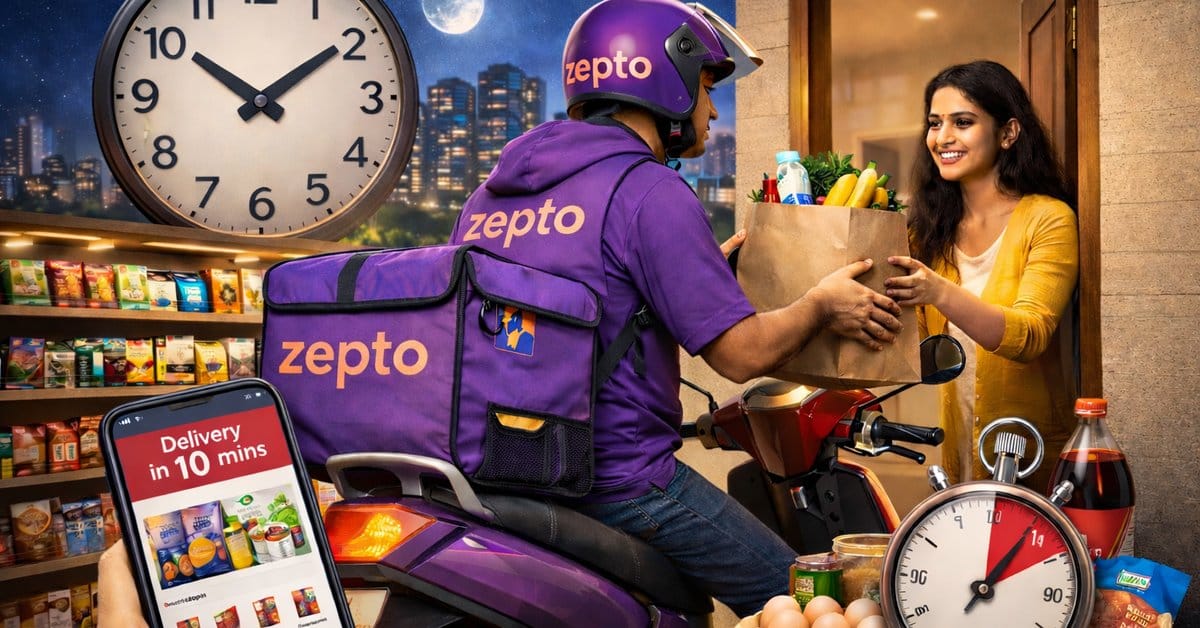
Most would guess Blinkit, but that is incorrect. The 10-minute delivery model was actually pioneered by Zepto in 2021, starting in Mumbai.
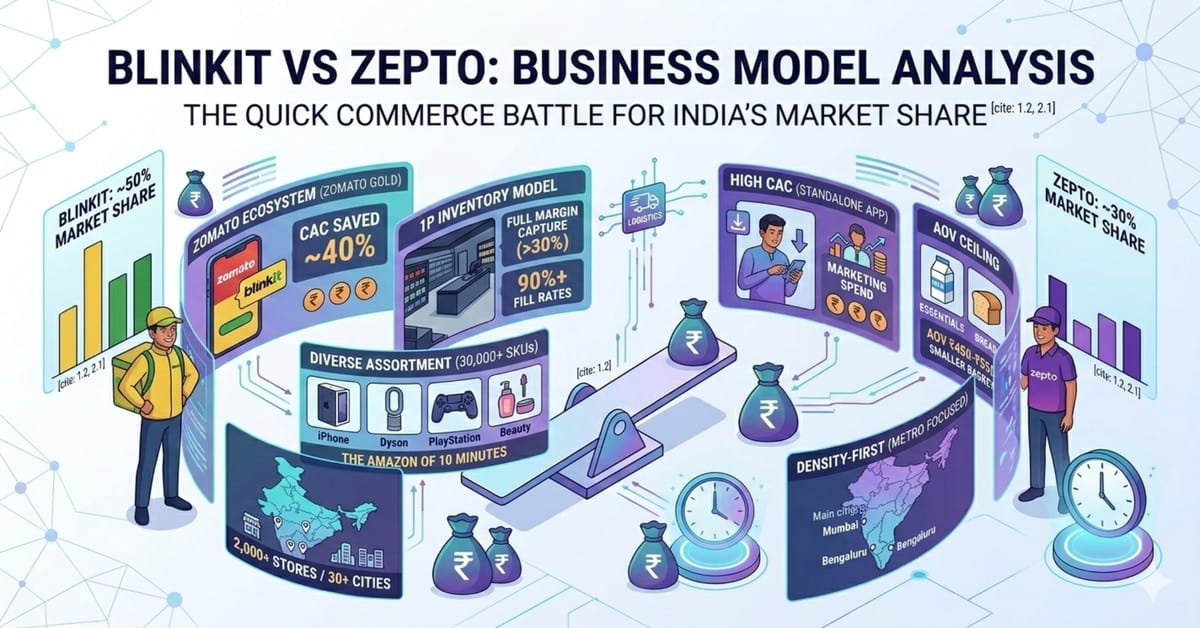
Conventional business wisdom says the “first mover” gets the advantage. Yet, if we look at the quick commerce market in India today, Blinkit owns a dominant 46–50% share, while Zepto holds approximately 26–30%. Why is the pioneer trailing the veteran?
Blinkit’s dominance is not merely a byproduct of aggressive capital infusion. Instead, when you break down the Blinkit vs Zepto business model, you see that Blinkit’s lead is the result of a powerful ecosystem, high-speed operational science, and a category expansion strategy that redefined what “instant delivery” actually means.
Table of Contents
Part 1: Why Blinkit is Leading the Race
Blinkit’s success is anchored in three strategic pillars that created a structural moat competitors have struggled to cross.
1. The Power of the Zomato Ecosystem
A major differentiator in the Blinkit vs Zepto business model is Blinkit’s deep integration into the Zomato ecosystem (acquired in August 2022 by Zomato for ₹4,447 crore ($568 million)). In the hyperlocal delivery space, Customer Acquisition Cost (CAC) is the “silent killer.” Independent players like Zepto must spend millions on advertising to get users to download their app.
Blinkit, however, has access to Zomato’s massive, pre-existing database of “India 1” consumers—the high-income urban segment.
- Reduced CAC: Blinkit converts Zomato food users into grocery shoppers through seamless in-app prompts. For example, a user finishing a food order on Zomato might receive a notification for dessert or snacks from Blinkit. This synergy reduces CAC by nearly 40% compared to traditional social media acquisition.
- Zomato Gold: By integrating the “Gold” subscription, Blinkit offers free delivery to millions of loyal users. In late 2025, Blinkit lowered the free delivery threshold for Gold members to ₹99, capturing the “small ticket” daily needs that users previously bought from local kirana stores.
2. The Great Pivot: Transitioning to an Inventory-Led Model
When looking at the Blinkit vs Zepto business model, a significant move behind Blinkit’s market capture was its total transition from a third-party marketplace to a full-stack, inventory-led model (1P system), officially completed on September 1, 2025.
- Margin Capture: In a marketplace model, platforms earn a 15–20% commission. By legally transitioning to an Indian-owned entity and owning the inventory outright, Blinkit captures the full retail margin, which can exceed 30% for high-value items.
- Reliability & Trust: This system eliminated “out-of-stock” frustrations. When third-party sellers fail to update inventory in real-time, customers lose trust. By owning the stock inside their micro-fulfillment centers, Blinkit ensures 90%+ fill rates and total quality control.
- Pricing Control: Inventory ownership allows Blinkit to dictate pricing and run aggressive “Super Saver” promotions that marketplace-led rivals cannot easily match.
3. Assortment Depth: The “Amazon of 10 Minutes”
Blinkit’s most aggressive move was expanding its catalog from 2,000 “emergency groceries” to over 30,000 diverse SKUs, including premium electronics and beauty brands like Apple, Dyson, and PlayStation.
- Economic Math: Quick commerce is essentially a logistics business. The cost to send a rider to a house is fixed (approx. ₹40–₹55). If a rider delivers a ₹60 packet of milk, the platform loses money. If that same rider delivers a ₹50,000 iPhone, the platform makes a significant profit.
- Average Order Value (AOV): High-margin items cross-subsidize low-margin staples. This is why Blinkit maintains an industry-leading Average Order Value (AOV) of ₹635–₹709, while rivals remain in the ₹450–₹550 range.
- Replacing Legacy E-commerce: When consumers realize they can get a charger, a printer, or a gift in 10 minutes, they stop waiting 48 hours for Amazon.
Part 2: Why Zepto is Lagging Behind
Despite its technological agility, the Blinkit vs Zepto business model comparison reveals three structural challenges that have capped Zepto’s growth.
1. The “Independence Tax”
Zepto is a standalone entity. Every new customer it acquires must be bought with fresh marketing dollars. Without a parent like Zomato to “borrow” users from—and fighting against the combined weight of Blinkit and Swiggy Instamart—Zepto’s marketing burn remains exceptionally high. This forces them to focus on metropolitan clusters where brand recall is highest, rather than nationwide expansion.
2. The AOV Ceiling
Zepto’s brand promise is built on ’10-minute speed for essentials.’ While this creates high frequency and makes it a daily habit, it also psychologically caps the ‘basket size.” Consumers often view Zepto as the “emergency milkman” rather than an “instant mall.” With a lower AOV (₹450–₹550), the fixed cost of delivery eats up a much larger portion of their margins compared to Blinkit’s electronics-heavy baskets, making the unit economics of quick commerce much harder to balance.
3. Metro-Density vs. National Infrastructure
Zepto has chosen a “Density-First” strategy, focusing heavily on the top 10 metro cities to ensure its 10-minute promise is never broken. While this makes them highly efficient in Mumbai or Bengaluru, it has allowed Blinkit to capture the “long tail” of India. Blinkit’s Push-Pull Model has allowed them to rapidly scale their dark store network to 2,000+ stores across 30+ cities, including Tier-2 markets like Jaipur and Lucknow.
Strategic Lessons from the Blinkit vs Zepto Business Model
The ultimate takeaway from the Blinkit vs Zepto business model is that Blinkit won 50% of the market not by being first, but by mastering the underlying math of the industry, through category expansion and ecosystem synergy.
- Own the stock: Transitioning to an inventory-led model gives you total control over customer experience and margins.
- Balance the basket: Use high-margin items (like electronics) to cross-subsidize the fixed costs of low-margin delivery (like milk).
- Leverage an ecosystem: A parent company’s existing user base is the ultimate weapon to slash customer acquisition costs.
In the high-velocity arena of quick commerce, speed gets the customer in the door, but assortment and ecosystem loyalty keep them there.
Your Action Plan: How to Apply This to Your Business
While the Blinkit vs Zepto business model operates on a massive, multi-billion-dollar scale, the exact same underlying math applies to your local startup or retail store. Here is how you can implement these lessons today:
1. Lower Your CAC and Increase Your CLV
These two metrics decide whether your business will struggle or thrive. Customer Acquisition Cost (CAC) dictates your survival, while Customer Lifetime Value (CLV) determines your longevity.
For example, if you spend ₹1,000 on Meta ads and acquire 4 buying customers, your CAC is ₹250 per customer. If those customers stay with you and make repeated purchases over the next few years, that accumulated revenue becomes your CLV. The golden rule of business is simple: push your CAC as low as possible, and maximize your CLV.
2. Be Omnipresent (Where It Matters)
You might not have the limitless funding of these quick-commerce giants, but you have something they struggle to scale: personalized customer satisfaction.
If you are not present where your customers spend their time—whether that is on social media or in your local community—you aren’t present at all. It is true that many physical grocery stores took a hit from 10-minute delivery apps, but the local stores providing exceptional service are still thriving and growing. Superior behavior and word-of-mouth marketing are your absolute best weapons to compete locally against the giants.
3. Build an Ecosystem Around Your Business
When analyzing the Blinkit vs Zepto business model, we saw how crucial a parent ecosystem is for long-term survival. But creating one isn’t just for massive tech companies.
For a small business, an ecosystem is simply a “retention loop”, a system where a customer naturally comes back to you for related needs through cross-selling or upselling. Don’t let the word “ecosystem” intimidate you.
Take a local clothes dry-cleaning service, for example. The standard transaction is simple: a customer drops off clothes, you clean them, and give them back. But there is a hidden opportunity here to build an ecosystem by stepping into the clothes-renting market (which is thriving in India). You could offer your customers free dry-cleaning or a revenue split if they allow you to rent out their premium ethnic wear. Just like that, you have created a self-sustaining loop that guarantees the customer keeps coming back to you.
FAQ’s
Why and who is winning when you compare the Blinkit vs Zepto business model?
Blinkit’s dominance comes down to superior unit economics rather than just speed. By integrating with Zomato, they drastically lower their Customer Acquisition Cost (CAC). Furthermore, their transition to an inventory-led model and expansion into high-margin categories (like electronics) gives them a much higher Average Order Value (AOV) than their competitors.
How does Zepto survive against massive ecosystems like Zomato and Swiggy?
Zepto relies on a highly efficient, density-first dark store network focused on top metro cities. Because they don’t have a parent app to funnel free traffic to them, they face an “independence tax.” To compensate, Zepto focuses obsessively on operational execution and extremely high-frequency retention to make their 10-minute grocery delivery profitable through sheer volume.
Is the 10-minute delivery model actually profitable?
It can be, but only if the basket math works. Delivering a ₹50 packet of milk costs the platform money due to fixed logistics and rider fees. The secret to a profitable quick commerce operation is cross-subsidization—getting the customer to add high-margin items like beauty products, chargers, or toys to their daily grocery cart to offset the delivery cost.


2 thoughts on “Blinkit vs Zepto Business Model: The Shocking Reasons Why One Dominates 50%”