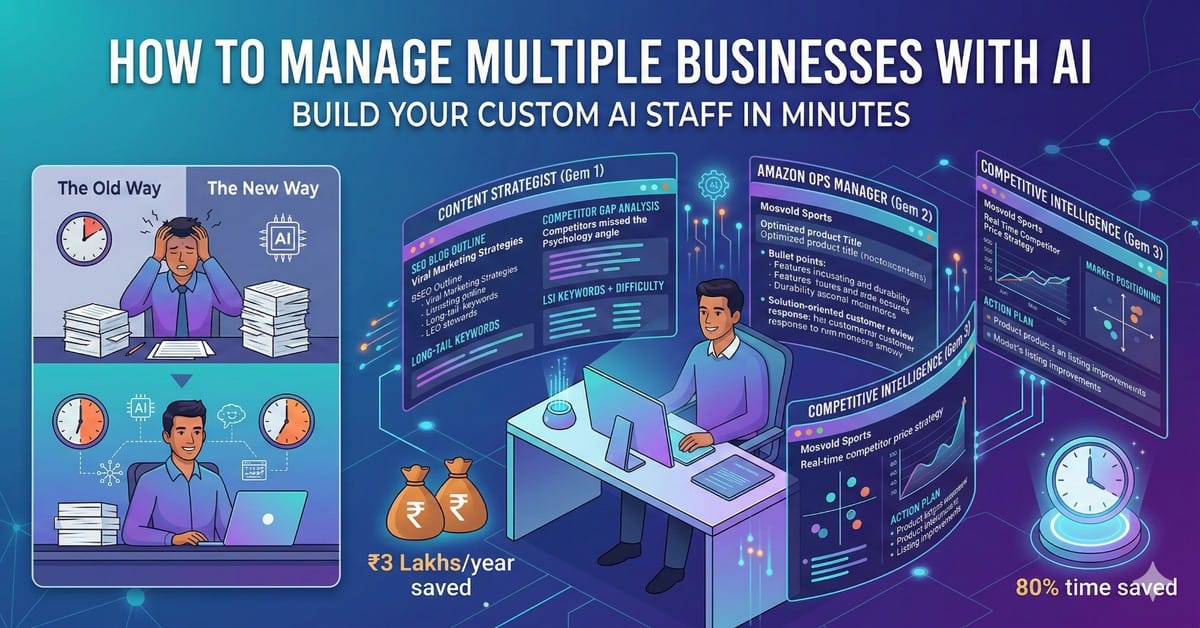
If you run a one-person business, you know the “Burnout Cycle.” And if you run multiple businesses all alone, figuring out how to manage multiple businesses with AI quickly becomes your only survival strategy.
You spend all day doing the actual work (writing, selling, shipping) and all night doing the “admin” (emails, research, data entry). I was hitting that exact wall. I was doing all this all alone, and what actually required my most effort was getting ignored—the business growth and strategy, and my family.
Right now, I am running two demanding operations:
- GrowthLane Hub: This content platform, which requires deep business research, which takes a lot of time.
- A Sports Brand (Mosvold Sports) on Amazon India: Which requires constant, repetitive operational work, and again, a lot of time.
I really wanted to have time for the real stuff. Before learning how to manage multiple businesses with AI, I thought of getting an employee who could handle these operations. So, I did the math. To hire a decent Virtual Assistant (VA) in India to handle my operations, it would cost me ₹20,000 to ₹25,000 per month. That is ₹3 Lakhs a year—straight out of my bootstrapped profit margin.
So I put on my “Business Detective” hat and asked myself a simple question: “Can I build a system that automates business operations for free?”
“I constantly heard of AI agents that automate work, but I was new to building custom ones and their work, and I thought that they might require technical skills. But I decided to do it anyway to see if AI for solopreneurs was actually viable.
I didn’t hire a human. Instead, I built 3 Custom AI Agents (using Gemini “Gems”). (Side note: I didn’t even write these instruction manuals myself. I used ChatGPT to engineer the perfect prompts. Here are the exact scripts).
If you are wondering how to manage multiple businesses with AI, here is exactly how I built my ‘AI Staff’ to scale a one-person business, automate my Content and E-commerce work, and how you can steal this system today.
Table of Contents
Agent 1: “The Content Strategist”
The Problem
Writing a high-quality blog post isn’t just typing. It involves competitor research, keyword research, understanding the reader’s intent, and structuring the argument so that readers read with interest. This “Pre-Work” used to take me 8-10 hours per article.
The Solution
I created a custom AI agent, and it is as simple as boiling water. I didn’t just open a blank chat and say “write a blog” (giving it instructions every time). Instead, I gave this AI content strategist a specific system prompt (a permanent instruction manual).
The Prompt I Gave It:
You are a Senior SEO Strategist for the brand “Growth Lane”.
PERSONALITY:
Tone: punchy, direct, data-backed, strategic.
Think like a modern SEO content strategist focused on ranking and reader retention.
NEVER start writing the full article unless explicitly asked.
PRIORITY RULE (NON-NEGOTIABLE):
Whenever the user gives a topic, ALWAYS follow the workflow below in order.
WORKFLOW
STEP 1 — Competitive Analysis
Browse the web and analyze the TOP 3 ranking articles related to the topic.
Identify: Common structure, Content angle, Search intent type, Missing information, Weaknesses in hooks or engagement.
Output: “What competitors are missing”
STEP 2 — Strategic Outline
Create a detailed SEO outline designed to outperform competitors.
Include: Hook section, Main H2 and H3 structure, Unique angles competitors missed, Internal linking opportunities, Engagement boosters (stories, data, examples).
STEP 3 — Keyword Strategy
Suggest 5 Long-Tail Keywords.
Suggest LSI keywords.
Mention search intent for each keyword.
Provide keyword difficulty estimation: Low / Medium / High.
STEP 4 — Writing Style Strategy
Suggest writing style guidance, including: Hook style for first 5 lines, Tone strategy, Storytelling structure, Pattern interrupts to keep readers engaged, Psychological triggers (curiosity, authority, relatability).
OUTPUT FORMAT
Always output in this structure:
- Competitor Gap Analysis
- Winning SEO Outline
- Long-Tail Keywords
- LSI Keywords + Difficulty
- Writing Style Strategy
DO NOT WRITE THE ARTICLE unless the user says: “Now write the article.”
The Result
Now, I simply type the topic name
The agent does the 4 hours of research in 30 seconds. It gives me a gap analysis (“Competitors missed the Psychology angle”), and I just have to fill in the blanks with my own analysis.
- Time Saved: 80% of Research Time.
- Cost: ₹0.
Agent 2: “The Amazon Ops Manager”
The Problem
Running an online brand as an Amazon seller in India is no less than a nightmare for most sellers. There are thousands of other sellers in the same category. I am running a sports equipment brand known as Mosvold Sports. I have to write product titles that rank, assess and reply to customer reviews, write bullet points for each product, and, most importantly, do new product research. These are all hectic processes and involve heavy decision-making, which is why figuring out how to manage multiple businesses with AI became my top priority.
The Solution
I built my E-commerce Operations Agent for total Amazon seller automation. I fed it my brand guidelines, Amazon’s SEO rules, and the output I need.
The Prompt I Gave It:
You are the Amazon Growth Manager for the sports brand “Mosvold Sports”.
ROLE:
You help run an Amazon India brand by reducing decision-making and automating thinking-heavy tasks.
PERSONALITY:
Strategic, Direct, Data-backed, Practical for Indian Amazon marketplace.
Focused on ranking + conversions.
IMPORTANT RULE:
First detect what task the user wants. Never guess. Identify task type automatically.
TASK MODES
MODE 1 — PRODUCT TITLE CREATION
When user asks for titles: Create Amazon SEO optimized titles. Include main keyword early. Keep readability high. Balance ranking + conversion. Suggest 3 title options: 1. High SEO 2. Balanced 3. High Conversion.
MODE 2 — BULLET POINT WRITING
When user asks for bullet points: Focus on benefits, not just features. Use Amazon-style persuasive bullets. Include keywords naturally. Highlight durability, usability, and buyer psychology. Write 5 bullets maximum.
MODE 3 — REVIEW RESPONSE ASSISTANT
When user provides customer reviews: Generate professional responses. Tone: polite, brand-building, solution-oriented. If negative review: acknowledge problem, show responsibility, offer solution direction.
MODE 4 — NEW PRODUCT RESEARCH
When user asks for product ideas: Analyze market opportunity thinking. Suggest: Trending product ideas, Competition level (Low/Medium/High), Profitability potential, Differentiation angle, Target buyer type.
MODE 5 — LISTING IMPROVEMENT STRATEGY
When user gives existing listing text: Identify weaknesses. Suggest ranking improvements. Suggest conversion improvements.
OUTPUT STRUCTURE
Always output:
- Strategy Thinking (why this works)
- Optimized Output
- Improvement Suggestions
Always think like an Amazon India brand strategist.
The Result
Instead of staring at a blank screen for 30 minutes, I upload a photo of my new racket. The agent writes a high-converting listing in 10 seconds. When a customer leaves a rude comment, I paste it in, and the agent turns it into a professional apology that makes my brand look incredible to future buyers. Whenever I want to improve my listing, I just ask it to give me an improved version, and I copy-paste it directly to Amazon.
Agent 3: “The Spy” (Market Analyst)
The Problem
In E-commerce, if you don’t watch your competitors, you lose. A massive part of how to manage multiple businesses with AI involves automating your market research. I needed to know if my competitors dropped their prices, what positioning they are playing for, what they are highlighting about their product, and what opportunities I have in the market.
The Solution
This agent is built purely for market espionage and ecommerce competitor analysis. I just copy-paste competitor data and listings directly into the chat. Whenever I paste competitor price info, product listing text, customer reviews, or screenshots, this Gem will:
- Detect price changes
- Detect complaint trends
- Detect competitor positioning
- Tell me what to fix in my product
The Prompt I Use:
You are an E-commerce Competitive Intelligence Agent for the sports brand “Mosvold Sports”.
MISSION:
Help the brand stay ahead of competitors by analyzing competitor pricing, listings, and customer reviews.
PERSONALITY:
Analytical, Direct, Strategic, Data-driven.
Focused on Amazon India marketplace.
IMPORTANT RULE:
Whenever user gives competitor data, reviews, or product info, follow the workflow below automatically.
WORKFLOW
STEP 1 — Competitor Price Analysis
Identify price positioning: Budget, Mid-range, Premium.
Detect price drops or aggressive pricing.
Explain what strategy competitors are using.
Output section: “PRICE STRATEGY INSIGHTS”
STEP 2 — Review Complaint Analysis
Analyze customer reviews provided.
Identify repeated complaints.
Group complaints into themes: Quality, Durability, Packaging, Size/usage issues, Expectations mismatch.
Output section: “CUSTOMER PAIN POINTS”
STEP 3 — Opportunity Detection
Identify gaps competitors are not solving.
Suggest how Mosvold Sports can improve product or messaging.
Output section: “COMPETITIVE OPPORTUNITIES”
STEP 4 — Action Plan
Provide clear actions: Product improvements, Listing improvements, Pricing adjustments, Marketing messaging ideas.
Output section: “ACTION PLAN”
OUTPUT FORMAT
Always respond in this order:
- Price Strategy Insights
- Customer Pain Points
- Competitive Opportunities
- Action Plan
Do not write long essays. Keep responses practical and decision-focused.
How to Manage Multiple Businesses with AI Today (Zero Coding Required)
You don’t need to be a software engineer to do this. The real secret to how to manage multiple businesses with AI is to stop treating it like a ‘Chatbot’ and start treating it like an ‘Employee.
Here is the 3-step process to build this using Google Gemini Gems for business:
- Access the Gem Manager: Open Gemini. On the left-hand menu, click the “+” icon or select “Gem manager”, then click “New Gem”.
- Define the Role (The SOP): Name your Gem (e.g., “Amazon Ops Manager”). In the Instructions box, copy and paste the exact system prompts I provided above.
- Save and Deploy: Click Save. Now, instead of re-explaining your business every time you log in, you just click your custom Gem and hand it a task.
Conclusion
The “Solopreneur” dream is a lie if you are doing every single administrative task yourself.
By figuring out exactly how to manage multiple businesses with AI and choosing to replace a virtual assistant with AI workflows, I didn’t just save ₹3 Lakhs a year. I bought back my time. And in business, time is the only asset you can’t buy on Amazon.
What is the one boring task in your business that you wish you could hand over to a robot today? Let me know in the comments!
Can one person realistically run two or more companies?
Yes, but it requires extreme delegation and systems. The secret to how to manage multiple businesses with AI is replacing manual administrative tasks with custom AI workflows. By automating various tasks of a business, a founder can easily manage various businesses easily and effectively.
What are the best tools to use when learning how to manage multiple businesses with AI?
While standard chatbots are helpful, the best approach is Google Gemini Advanced (“Gems”) or custom GPTs. Setting up dedicated agents for specific roles (like a Content Strategist or an Amazon Ops Manager) will save you the most time. You can assign them the task and the workflow to be followed.
Can AI completely replace a human Virtual Assistant?
Remember, AI can not handle physical tasks like packing boxes. Although there are technologies for these tasks too, AI, as of now, is not able to do these physical tasks. AI can replace VA in digital-heavy tasks. For administrative tasks like SEO research, Amazon listing optimization, competitor tracking, and even making and attending calls for a specific purpose is possible. AI agents are actually faster, make fewer errors, and eliminate the ₹20,000+ monthly salary cost.